
Engineering calculations can predict how a bridge should perform. But until recently, no one had tested a full-size bridge under the same conditions it would experience in the real world.
To provide engineers with valuable real-world performance data, Bedford Reinforced Plastics partnered with West Virginia University to conduct the first-known full-scale test of a 100-foot by 10-foot fiberglass-reinforced polymer (FRP) truss bridge designed to accommodate a single H-5 emergency vehicle. While coupon-level material testing is common, testing an entire bridge system at its actual size and under actual loading conditions is unprecedented.
Watch the video below to see how the bridge performed under vehicle loads, heavy pedestrian traffic, extreme wind conditions and long-term loading.
“There has never been a test such as the one that we are experiencing or witnessing today in the sense that a full-scale bridge such as this has never been built to its actual size and tested with the actual loads that the bridge would experience.”
— Aldred D’Souza, P.E., Engineering Director, Bedford Reinforced Plastics
Why Full-Scale Testing Matters
After the bridge was fabricated, researchers assembled it on the university grounds and subjected it to the same loads used during the design process.
The testing program evaluated several key performance characteristics, including:
- Vehicle load capacity
- Vertical deflection under live loads
- Lateral force resistance
- Vibration and pedestrian comfort
- Long-term creep behavior
- Strain and overall structural capacity
The objective was simple: verify that the bridge would behave in the field exactly as engineers predicted.
According to D’Souza, the results met expectations. “The bridge behaved exactly like we predicted it to behave. It performed extremely well under the vehicle load and under the live load of 70 PSF.”
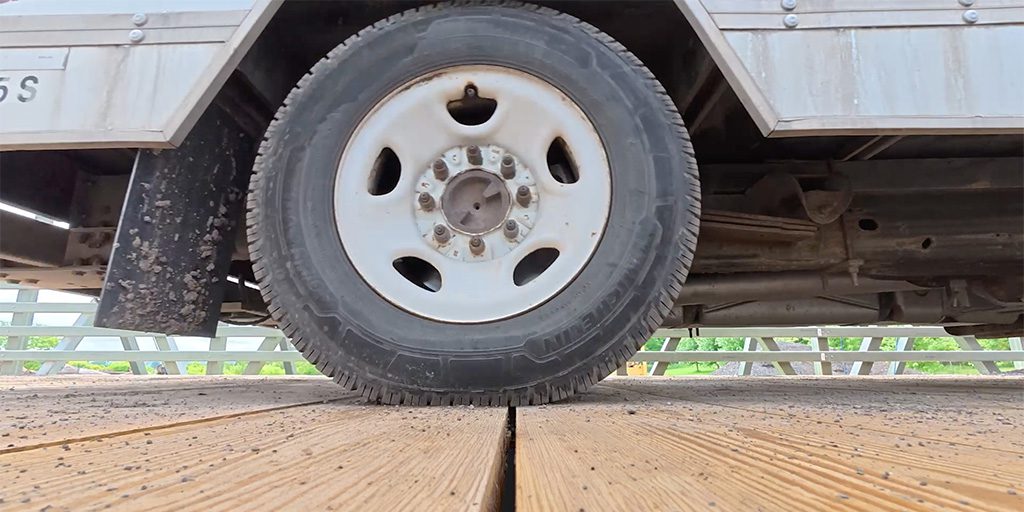
Simulating an H-5 Emergency Vehicle
One of the most significant tests evaluated the ability of the FRP truss bridge to support emergency access.
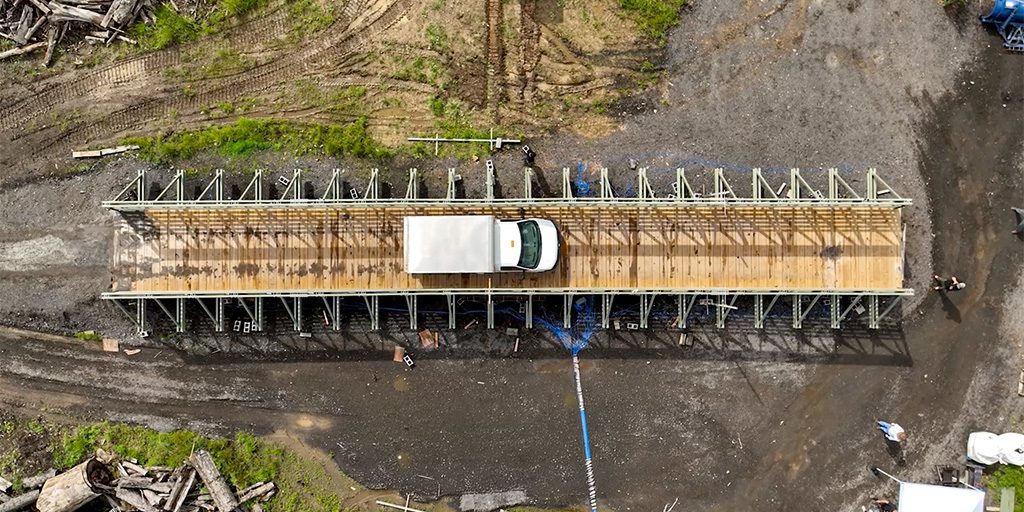
To simulate an H-5 vehicle, researchers loaded a U-Haul truck weighing 5,790 pounds with an additional 4,000 pounds of sandbags. The nearly 10,000-pound load demonstrated that Bedford pedestrian bridges can safely support emergency access when it matters most.
Researchers also evaluated the bridge under a uniformly distributed live load of 70 pounds per square foot, representing heavy pedestrian traffic. The bridge recorded an instantaneous vertical deflection of just 3.27 inches — well within engineering requirements.
Testing Against Extreme Wind Forces
Lightweight construction is one of the many advantages of FRP, but some assume it comes at the expense of stability. Full-scale testing proved otherwise.
Researchers performed a lateral force resistance test equivalent to wind speeds of 120 miles per hour — approximately a 700-year storm event. Even under those conditions, the bridge experienced a transverse deflection of only 5.39 inches.
The results demonstrated that extreme wind forces are not a concern for the performance and longevity of Bedford FRP bridges.
Performance Built for the Long Term
Bridge owners expect structures to maintain both their appearance and performance over decades of use.
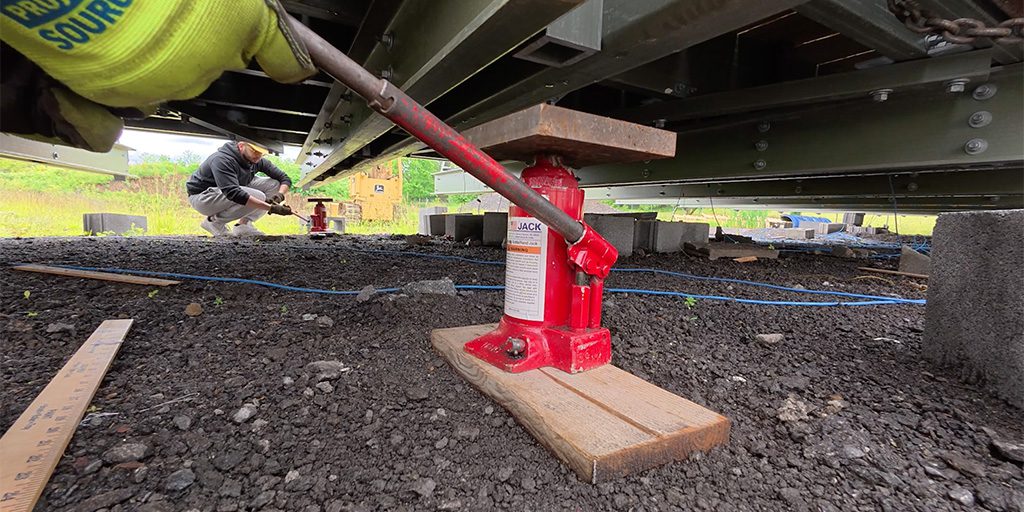
To evaluate long-term behavior, researchers monitored creep deflection over five days while the bridge was subjected to a 70 PSF load. The maximum creep deflection measured just 0.55 inches.
Bedford’s pre-stressed assembly method helps maintain camber and keeps the bridge level throughout its service life.
Validating Engineering with Real-World Data
For Bedford, the testing wasn’t simply about gathering numbers. It was about validating that computer models accurately predict real-world performance.
“The results we’re getting in a computer analysis are going to be the same in real life,” said Camilo Sierra, Structural Engineer at Bedford. “That’s why full-scale testing is required on these types of structures.”
Strain measurements showed that the bridge reached only 25% of its total capacity during testing, providing additional confidence in the design.
“When clients witness a full-scale test such as this, they have additional confidence that the bridge they’re buying will perform the way they expect it to perform,” added D’Souza.
For engineers, owners and communities, confidence comes from knowing that a bridge will perform as expected — not just in theory, but in reality.
Explore Bedford Pedestrian Bridges
From lightweight construction and corrosion resistance to proven real-world performance, Bedford FRP truss bridges are designed to deliver decades of dependable service.
To learn more about Bedford’s pedestrian, equestrian and golf course bridge solutions, contact our team or call 814.623.8125.